Completing the online application for company registration in Bulgaria can be done in approximately five minutes.
The actual registration process of a company in Bulgaria takes around four working days.
The overall time frame for completing the business registration process is typically around two working weeks.
Costs associated with the business registration fees include all applicable taxes and fees:
If the owner is a foreign legal entity, the starting cost for registration is from €1200.
The estimated cost if the manager and shareholder are present in Bulgaria is €600.
If management and shareholder personnel are not present in Bulgaria, additional costs of €800 will apply.
After company registration in Bulgaria, you will receive a verified official certificate.
The registration process in the Commercial Registry includes opening a special account, submitting capital, and paying required fees.
Legal Requirements for Company Formation
The company registration process in Bulgaria involves:
Choosing a business entity
Preparing required documentation
Opening a bank account
Fulfilling tax and compliance registrations
Documentation needed includes:
Certificate of Incorporation
Memorandum and Articles of Association
Declaration of the Shareholders
Power of Attorney
Notarized identity documents
Before starting the entity registration, additional required documents include:
Notary-certified statement of consent
Signature specimen of the manager
Certified copy of Articles of Incorporation
Bank certificate for at least 70% of the minimum required capital
After completing company registration in Bulgaria, it is necessary to:
Register for VAT
Open a Business Bank Account
Minimum corporate requirements:
At least one director is required
At least one shareholder is required (can be an individual or a legal entity, resident or foreigner)
There is no requirement for local directors
To establish a physical presence in Sofia, a registered office must be maintained at a Bulgarian address.
Minimum Share Capital
Minimum share capital is a crucial aspect of company formation, determining the financial commitment and credibility of the business.
The initial capital for a Limited Liability Company in Bulgaria can be as low as 1 Euro.
It is recommended to register a higher initial capital to enhance business credibility and attract investment.
Compliance with Bulgarian Legislation
Compliance with Bulgarian legislation is crucial for businesses operating in Sofia to avoid legal penalties and ensure smooth operations.
Ongoing legal support helps businesses navigate specific compliance issues and updates in Bulgarian law.
Access to specialized legal aid helps ensure compliance with local business laws and regulations.
It is important for businesses to stay compliant with the corporate tax rate, which in Bulgaria is a flat rate, and recognize the need for VAT registration.
Companies are required to prepare and submit annual financial statements to comply with local regulations in Bulgaria.
Companies in Bulgaria benefit from services that include:
Payroll management
Tax advice
Financial reporting
Payroll service providers in Bulgaria can assist with ensuring compliance with tax regulations and timely submissions.
Taxation and Financial Reporting
New legislation requiring public country-by-country reporting for multinational enterprises comes into effect on January 1, 2025.
Accountancy services also include annual financial reporting and compliance with local tax regulations.
Corporate Income Tax
The corporate tax rate in Bulgaria is one of the lowest in Europe, set at a flat rate of 10%.
Bulgaria employs a flat tax rate system, meaning all corporations are taxed at the same rate without complex tax brackets.
The dividend tax rate in Bulgaria is set at 5%, which is advantageous for businesses distributing profits to shareholders.
VAT Registration
In Bulgaria, all eligible businesses must register for VAT.
To obtain a VAT number, an application must be submitted to the National Revenue Agency along with the following:
Foundation deed
Bank account document
Excerpt from the Commercial Register
The standard VAT rate in Bulgaria is 20%, with a reduced rate of 9% applicable in certain cases.
After company registration, businesses can access additional services including VAT registration.
Annual Financial Statements
Annual financial statements are essential for compliance with Bulgarian law and reflect a company’s financial health.
The deadline for submitting the annual tax return in Bulgaria is at the end of March.
Compiling annual financial statements is a standard accounting service for companies in Bulgaria.
Advantages of Doing Business in Sofia
Sofia’s strategic location provides easy access to major European markets and enhances trade opportunities.
Bulgaria’s EU membership offers businesses numerous advantages such as free trade agreements and financial support.
Bulgaria employs a flat corporate income tax system, providing simplicity and predictability for businesses.
At 10%, Bulgaria maintains one of the lowest corporate income tax rates in the European Union.
Bulgaria offers a highly educated and skilled workforce, which is advantageous for companies looking to hire talent.
Establishing a business in Bulgaria allows access to an investment-friendly environment and a stable legal framework.
Business consulting services can provide essential insights for strategic planning and operational efficiency in Bulgaria, often focusing on market analysis and growth strategies.
Strategic Location
Sofia’s location within the EU provides significant strategic advantages for businesses, enhancing access to European markets.
Bulgaria’s legal system aligns with EU law, ensuring compliance and benefiting companies operating across the EU.
Overall, Sofia’s location and EU membership create a business-friendly environment for international growth.
Low Taxes and Competitive Costs
Flat corporate tax rate of 10% – among the lowest in the EU
Highly attractive for foreign investment due to simple and low taxation
Lower cost of living compared to many EU countries
Reduced operating costs, including rent and utilities
Minimal social security contributions help reduce employment expenses
The combination of low taxes and competitive costs makes Bulgaria a top destination for business setup
Skilled Workforce
Sofia boasts a well-educated and highly skilled workforce
Employees are known for strong educational backgrounds and technical skills
Majority of the workforce is multilingual, facilitating international operations
This presents significant advantages for globally-oriented businesses
Post-Registration Services
After company registration in Bulgaria, a wide range of additional services are available, including:
Accounting filings
VAT registration
Apostille services
Translations and legalizations
Incorporation services ensure smooth operations with support and follow-up services.
Shelf companies are available for immediate use and include:
Business office
VAT number
Articles of Association
Certificate of incorporation
Businesses can also utilize virtual office packages for legal registration and administrative support.
Accounting and Bookkeeping
Professional accounting services are essential for maintaining the financial health and compliance of businesses in Bulgaria.
The primary accountancy services provided for companies in Bulgaria include:
Monthly bookings
VAT filings
Annual reports
Tax declarations
Utilizing these accountancy services helps businesses ensure they meet regulatory requirements and maintain accurate financial records, promoting long-term sustainability.
Legal Support
Legal support is essential for navigating complex Bulgarian laws and regulations when starting a business.
Having specialized legal assistance ensures compliance in key areas and complements accountancy services.
Business Consulting
Business consulting services can significantly enhance a company’s growth trajectory by providing expert insights and strategies tailored to specific market needs.
These services assist businesses in:
Identifying new opportunities
Optimizing existing processes
Formulating effective growth strategies
Consulting services also play a crucial role in strategic planning, guiding businesses on long-term objectives and execution methods.
Overall, business consulting provides actionable insights, enhances organizational effectiveness, and supports competitive advantage.
Do you know your leave rights as an employee in Bulgaria?
Whether you’re a seasoned professional or new to the workforce, understanding the fundamental aspects of Bulgaria’s labor laws is crucial.
With a focus on fostering a balanced work-life dynamic, we uncover the legal landscape ensuring employees rest and recuperate while meeting employers’ operational needs. Join us as we explore everything you need to know about taking time off in Bulgaria, ensuring you’re well-equipped to make informed decisions about your leave rights.
What Are the Basics of Employee Leave Rights in Bulgaria?
Understanding employee leave rights in Bulgaria is essential for anyone working in or with businesses in the country. Bulgarian labor laws offer comprehensive guidelines to secure both employees’ well-being and employers’ operational needs. This coverage ensures that every individual in the workforce is well-informed about their entitlements, fostering a culture of respect and mutual understanding in the workplace.
Overview of Bulgarian Labour Law on Leave Rights
The foundation of leave rights in Bulgaria is built upon national legislation, including the Labor Code and health and safety regulations, as well as international conventions that the country has ratified. These laws stipulate the minimum standards for various types of leave, including annual paid leave, maternity and paternity leave, and provisions for unpaid leave under certain conditions. Importantly, these rights aim to balance the necessity for rest and recuperation for employees with the practical needs of employers to manage their operations effectively.
In Bulgaria, the labor law mandates that employees are conferred specific leave entitlements such as the right to a minimum amount of paid annual vacation, maternity leave assisting new parents, paternity leave recognizing the importance of fatherhood, and other unpaid leave options permitting individuals to address personal matters. The legislation’s breadth underscores the country’s commitment to protecting workers while accommodating the diverse needs of modern families and individual circumstances.
How Many Days of Annual Leave Are Employees Entitled To?
One of the fundamental aspects of employment rights in Bulgaria is the entitlement to annual paid leave. Employees who have worked for at least four months are eligible for a minimum of 20 working days of paid vacation. This provision ensures that all workers have the opportunity to rest, leading to better health and increased productivity. The law offers flexibility, allowing employers to extend these benefits and recognizes the importance of leisure in fostering a motivated and healthy workforce.
The significance of this entitlement cannot be understated. It represents a critical component of Bulgaria’s labor laws, designed to guarantee that workers have adequate time away from their jobs to recharge. This regulation reflects a fundamental understanding that rest and leisure are not luxuries but necessities for maintaining a balanced, healthy lifestyle conducive to sustained professional performance.
In summary, Bulgaria’s labor laws provide a solid framework to protect workers‘ rights to take time off from work. These provisions support the physical and mental well-being of the workforce, ensuring that employees have sufficient opportunities to rest, which in turn can contribute positively to the productivity and success of businesses throughout the country.
Types of Paid Leave in Bulgaria Explained
Understanding the landscape of paid leave in Bulgaria requires familiarity with several key types of leave mandated by law. These include annual leave, maternity and paternity leave, and sick leave, among others. This guide aims to shed light on these entitlements in a way that is easy to understand, helping employees in Bulgaria to better navigate their rights.
Breaking Down Holiday Leave Entitlements
In Bulgaria, the law ensures employees are entitled to holiday leave for rest and recreation. All workers, following a minimum of eight months of employment, are eligible for at least 20 working days of paid annual leave. Certain groups, like those under 18 or with a disability level of over 50%, are entitled to a minimum of 26 days. Additionally, those in specific employment conditions may qualify for extended leave ranging from 30 to 48 days. This entitlement supports work-life balance, allowing employees significant time away from work for relaxation.
The Ins and Outs of Maternity and Paternity Leave
Maternity leave in Bulgaria is generously provisioned with up to 410 days off, 135 of which are paid, divided into periods before and after childbirth to support the health of both mother and child. Male employees are not left out, as the law provides fathers with 15 days of paid paternity leave following the birth or adoption of a child, with the possibility of an additional two months to assist in early child-rearing activities.
Understanding Sick Leave Policies in Bulgaria
Sick leave policies allow employees to take necessary time off for health reasons. In Bulgaria, employees can avail themselves of sick leave with partial salary compensation provided by the National Health Insurance Fund, following an evaluation of their condition. This policy is designed to ensure that employees do not feel compelled to work while unwell, promoting a healthier work environment.
Special Leave: Bereavement, Jury Duty, and Military Leave
Apart from the more commonly discussed types of leave, Bulgarian employment law also recognizes the need for leave during significant life events and duties. Bereavement leave provides employees with time off following the loss of a close family member, allowing them time to grieve and manage affairs. Jury duty leave ensures that employees can fulfill their civic obligations without penalty. Lastly, military leave is available for those required to partake in military service or training, recognizing the importance of national duty while preserving employment rights.
Each type of leave plays a vital part in ensuring the well-being of employees, showing a commitment to work-life balance and employee health in Bulgaria. Whether facing significant life changes, fulfilling civic duties, or simply in need of rest, Bulgarian labor laws are structured to support employees through various stages and needs, ensuring their rights are protected while promoting a healthy balance with work commitments.
Public Holidays: What You Need to Know
Understanding public holidays is essential for both employers and employees to manage leave entitlements and benefits effectively in Bulgaria. The country recognizes a series of national public holidays each year, which are statutory non-working days. These days are set aside to celebrate historical, religious, and cultural events significant to the nation’s heritage. Recognizing these holidays helps foster a sense of national pride and community spirit while ensuring employees have the opportunity to rest and participate in these important celebrations.
A Closer Look at National Public Holidays in Bulgaria
Bulgaria celebrates a rich tapestry of public holidays spanning historical commemorations, religious festivities, and days dedicated to national unity and cultural heritage. Some of the key public holidays include Liberation Day, commemorating Bulgaria’s liberation from Ottoman rule, and Independence Day, which celebrates the country’s declaration of independence. Additionally, religious holidays like Easter and Christmas are observed with one or more days off, reflecting the country’s strong Orthodox Christian tradition.
1 January: New Year’s Day
3 March: Liberation Day
1 May: International Workers’ Day
6 May: Saint George’s Day
24 May: Bulgarian Education and Culture and Slavonic Literature Day
6 September: Unification Day
22 September: Independence Day
24 December: Christmas Eve
25 & 26 December: Christmas Day
Four Easter Holidays: Good Friday, Holy Saturday, Easter Sunday, and Monday per the calendar year
The recognition and observance of these holidays play a crucial role in honoring Bulgaria’s rich history and cultural heritage, while also allowing citizens to rest and celebrate with family and friends. Employers need to account for these holidays in their operational planning and ensure compliance with the labor laws regarding holiday pay and employee leave entitlements.
How Public Holidays Affect Leave Calculations
One critical aspect of Bulgaria’s labor laws is the treatment of public holidays in relation to employee leave entitlements. The law mandates that public holidays are not to be counted as part of an employee’s annual paid leave. This means that if a public holiday falls within an employee’s vacation period, it does not deduct from their accrued leave days.
For instance, should an employee take a vacation that spans a public holiday like Liberation Day or Independence Day, this day would not be subtracted from their total annual leave entitlement. This provision ensures that employees receive their full complement of vacation time, in addition to observing national holidays. Furthermore, when employees are required to work on a public holiday, they are entitled to receive additional compensation or compensatory rest, per Bulgaria’s labor regulations.
This approach to public holiday and leave calculations underscores the importance of maintaining a work-life balance by ensuring employees have adequate rest and recreation time. Employers must carefully plan and manage work schedules to accommodate public holidays and comply with labor laws regarding leave and compensation. Understanding these rules helps promote a harmonious and lawful workplace environment, reflecting the value placed on rest, celebration, and national pride in Bulgarian society.
Navigating Unpaid Leave in Bulgaria
In Bulgaria, employees have the option to request unpaid leave for various personal reasons, spanning from the need for extended personal time to tending to family matters. Unlike paid leave, the right to unpaid leave is not automatically granted by accumulation of working hours or tenure but requires the employer’s consent. This flexibility can be a valuable tool for employees seeking time off that extends beyond their paid leave entitlements.
When Can Employees Take Unpaid Leave?
Unpaid leave in Bulgaria can be requested by employees at any time during their employment, independent of the duration of their service or their utilization of annual paid leave. This arrangement offers workers an opportunity to manage personal commitments or pursue activities of personal growth without the constraint of only using their allocated paid vacation days. However, it’s crucial for employees to understand that the approval of unpaid leave is at the discretion of their employer, who will consider the impact of the employee’s absence on the operation before making a decision.
There is no specified minimum employment period required to apply for unpaid leave.
Employees do not need to exhaust their paid leave before applying for unpaid leave.
Unpaid leave must be requested in writing, providing a reasonable amount of notice to the employer.
Legal Protections for Employees on Unpaid Leave
The Bulgarian labor law provides certain protections for employees who are on unpaid leave. One of the key features is the inclusion of up to 30 days of unpaid leave within the calculation of the employee’s length of service. This consideration ensures that short periods of unpaid leave do not negatively impact an employee’s overall service tenure, which can be important for future entitlements like paid leave accumulation and severance calculations. However, employees should note that any period of unpaid leave exceeding 30 days will not be accounted for in the total length of service.
Up to 30 days of unpaid leave are considered when calculating service length for entitlements.
Unpaid leave exceeding 30 days does not count towards the length of service.
The protection does not cover salary or wage payments; employees are financially responsible during their unpaid leave period.
Understanding the right to unpaid leave and the associated legal protections ensures that employees can make informed decisions about taking time off work. It provides a legal framework that respects the needs of both the employee and the employer, balancing personal freedom with organizational requirements. For those needing extended time away from work, unpaid leave can be a valuable option, provided the implications, especially in terms of service length and financial preparedness, are thoroughly considered.
Unique Leave Types: Study, Adoption, and More
In today’s ever-evolving workplace, understanding and navigating the variety of leave types available to employees is crucial. This guide delves into some of the unique leave options that cater to specific life events and needs, such as educational pursuits, adoption processes, and more. By covering these areas, we aim to shed light on the support structures in place for individuals seeking personal growth or welcoming new family members.
Expanding Horizons: Educational Leave Benefits
Investing in education is not just beneficial for personal development but also contributes to workplace advancement. Recognizing this, several leave policies support employees in pursuing secondary and higher education. Employees are entitled to 25 days of paid leave per calendar year for educational purposes. This provision is designed to facilitate attendance in courses, exams, and even thesis or dissertation work, without the stress of losing income.
For exam preparation and taking: Up to 20 working days of unpaid leave per academic year.
For school entrance exams, state examinations, or final project preparations: Leave duration varies, with specific entitlements for each educational level, including up to 30 working days for secondary education and up to 4 months for higher education and doctoral studies.
These benefits underline the importance of supporting lifelong learning and ensuring employees do not have to choose between their careers and educational aspirations.
Growing Families: Adoption Leave Policies
The journey of welcoming a new child into the family is a monumental one, and adoption leave policies provide essential support during this time. Parents who adopt are granted 365 days’ leave, commencing from the day of adoption. This leave ensures that parents have time to bond with their adopted child, settle them into their new home, and take care of all the necessary legal and societal adjustments. The cash benefit received during this period is equivalent to 90% of the employee’s average daily gross salary, thus offering financial stability as well.
The leave can also be shared or transferred between the adoptive mother, father, or even grandparents, provided they are employed and meet certain insurance conditions. In cases where a married couple adopts, the adoptive father is entitled to 15 days of paid leave, further promoting shared parental responsibilities and support.
Other Specialized Leaves and Their Regulations
Beyond educational and adoption leave, there are several other types of specialized leaves designed to meet the diverse needs of employees. These include:
Parental Leave: Available until the child reaches 2 years of age, with a monthly compensation to support the family. This leave can be shared among family members under specific conditions, fostering flexibility and shared caregiving responsibilities.
Breastfeeding Leave: Granted until the child is 8 months old, this leave allows mothers to take breaks during the workday for breastfeeding, ensuring the well-being of both mother and child.
Unpaid Parental Leave: Up to the child’s 8th birthday, parents can request unpaid leave for up to 6 months, which can be transferred to the other parent under certain conditions. This provision caters to the evolving needs of families as children grow.
Civic Duty Leave: Ensuring employees can fulfill their civic responsibilities, this leave covers situations such as court appearances, military service, or participating in disaster protection initiatives without fear of losing their job.
Each of these leave types recognizes the multifaceted lives of employees, offering support and flexibility for personal and family needs, educational growth, and civic responsibilities. By fostering an understanding and supportive work environment, employers can contribute positively to the well-being and development of their workforce.
Complying with Bulgarian Labour Law: A Guide for Employers
Understanding and adhering to Bulgarian labour law is crucial for employers operating in the country. It’s not just about following rules—it’s about creating a fair, respectful, and safe work environment for all employees. With a focus on leave entitlements, this guide provides an overview of what employers need to know to fulfill their legal and ethical obligations.
Key Responsibilities of Employers Regarding Leave Rights
Employers in Bulgaria are tasked with several important responsibilities when it comes to managing leave entitlements for their workforce. These include:
Granting a minimum of 20 working days of paid annual leave, with the potential for extension based on specific employee conditions or collective agreements.
Ensuring maternity leave entitlements are upheld, offering a minimum of 58.6 weeks off, portioned into maternity and additional rest periods as required by law.
Providing 15 days of paid paternity leave for new fathers, with additional provisions for extended leave to assist in child-rearing.
Adhering to labor laws regarding unpaid leave, which may be offered for various personal reasons, including but not limited to educational pursuits, bereavement, or family care.
Additionally, it’s imperative to maintain records and document all leave transactions to ensure compliance with Bulgarian labor law and support ethical labor practices.
Penalties for Non-Compliance with Leave Entitlements
Failure to comply with the leave entitlements as per Bulgarian labor law can have significant consequences for employers. These penalties are designed to enforce the law and ensure that employees are treated fairly. They include:
Financial penalties and fines determined by the level of infringement, which could significantly impact the organization’s financial standing.
Reputational damage that can arise from legal disputes or public disclosure of non-compliance incidents, potentially leading to a loss of consumer trust and difficulty in attracting top talent.
Legal actions, including litigation by affected employees, can result in court orders mandating back pay for leave entitlements or other compensations.
Understanding these responsibilities and potential penalties is essential for employers to foster a compliant and positive working environment. Staying informed about changes in labor law and seeking legal advice when necessary can help avoid these penalties and promote a culture of respect and fairness in the workplace.
FAQ Section: Answering Your Questions About Leave Rights
How Does Carryover Vacation Work in Bulgaria?
In Bulgaria, carryover vacation is a practical approach to ensuring employees do not lose out on their valuable rest periods due to work commitments or other reasons. Employees are entitled to a minimum of 20 working days of paid annual leave, with certain positions receiving more, based on specific conditions set in the Bulgarian Labour Code. Should this leave remain unused by the end of the year, the law mandates employers to allow its utilization within the next calendar year, no later than 6 months past the original year. This provision ensures that employees have adequate opportunities to use their leave for relaxation and personal time off.
If an employer fails to ensure the employee takes their annual leave within this period, employees have the right to decide on the timing of their leave. They must notify the employer in writing 14 days in advance. Importantly, unused paid annual leave expires two years after the year it was accrued, making it essential for employees to plan their leave periods within this timeframe to avoid forfeiture.
Can Employers Deny Leave Requests?
Employers in Bulgaria have certain obligations to accommodate leave requests, but there are scenarios where denying leave might be necessary, primarily for business-critical reasons. When leave is postponed due to urgent work needs or an employee-initiated postponement, such as taking another type of leave or by mutual agreement, employers face the challenge of balancing operational demands with employee rights.
However, it’s crucial for employers to act within the legal framework and provide justifiable reasons for any denial or postponement of leave. They are required to notify employees in writing of their annual leave entitlement, including any carryover leave, by January 31st of each year, fostering transparency and enabling better planning for both parties. Employers must also respect the two-year expiration rule for unused leave, ensuring employees have ample opportunity to use their leave entitlements.
What Happens During Maternity or Paternity Leave?
Maternity and paternity leave in Bulgaria are designed to support parents during the critical early months of child-rearing, enabling them to focus on family without the added pressure of work commitments. Maternity leave is exceptionally generous, offering a statutory entitlement of 410 days (approximately 58.6 weeks), with 45 days to be taken before the due date and the remainder divided between post-birth recovery and caregiving. During this period, employees are entitled to 90% of their full salary, provided through the National Health Insurance Fund, ensuring financial stability for the family.
Paternity leave further supports familial bonds by granting male employees 15 days of paid leave upon the birth or adoption of a child. Additionally, the Bulgarian labour code provides the option of two months of leave to care for a child under eight years of age, emphasizing the country’s dedication to family welfare and child development. These leaves are integral to supporting parents in Bulgaria, balancing work responsibilities with the demands of family life.
Final Thoughts on Navigating Employee Leave Rights in Bulgaria
Understanding and complying with the employee leave rights in Bulgaria is critical for both employers and employees operating within the country. The Bulgarian Labour Code sets clear guidelines on paid annual leave, entitlements, and the conditions under which leave can be postponed or carried over. With a minimum of 20 working days of basic annual leave granted to every employee following a 4-month work experience period, Bulgaria ensures workers have adequate rest and personal time away from their duties. This provision not only supports the well-being of employees but also aligns with the country’s commitment to promoting work-life balance and improving job satisfaction.
For employers, adhering to these rules is not just about legal compliance but also about fostering a positive work environment. By ensuring that employees are aware of their leave entitlements, through written notifications by January 31st of each year, and facilitating the use of this leave, employers contribute to a culture of respect and fairness. It’s important for businesses to manage payroll and leave policies effectively to avoid potential legal repercussions and to maintain a motivated workforce. This includes managing unused leave by allowing carryover into the next calendar year and ensuring that any postponed leave is used within the stipulated periods.
The restriction on monetary compensation for unused annual leave, except upon employment termination, emphasizes the importance of encouraging actual leave-taking for rest and recuperation. Employers and employees alike should be aware of the parameters for leave postponement and the rights of employees to schedule their leave if not facilitated within the allowed timeframe. This structured approach to leave management underlines the significance of planning and mutually respecting the provisions laid down by labor laws in Bulgaria.
Did you know that understanding current VAT rates is crucial for navigating the Value Added Tax (VAT) landscape across the European Union in 2025? From the low of 17% in Luxembourg to a staggering 27% in Hungary, the VAT landscape reflects the diverse fiscal strategies of EU member states.
Join us as we explore the intricacies of VAT in 2025, a journey that promises to shed light on this critical component of the EU’s economic framework.
Introduction to VAT Rates
Value Added Tax (VAT) is a consumption tax applied to nearly all goods and services bought and sold for use or consumption in the European Union (EU). The EU has standard rules on VAT, but these rules may be applied differently in each EU country. VAT rates vary across EU countries, with each member state setting its own rates. The standard VAT rate cannot be less than 15%, and one or two reduced rates may be applied to specific goods and services. Understanding VAT rates is crucial for businesses operating in the EU, as it directly impacts their tax obligations and financial management.
What Are the Standard VAT Rates Across the EU in 2025?
Country
Standard VAT rate
Reduced VAT rate 1
Reduced VAT rate 2
Super reduced VAT rate
Parking VAT rate
Austria
20%
10%
13%
–
13%
Belgium
21%
6%
12%
–
12%
Bulgaria
20%
9%
–
–
–
Croatia
25%
5%
13%
–
–
Cyprus
19%
5%
9%
–
–
Denmark
25%
–
–
–
–
Estonia
22%
9%
–
–
–
Finland
24%
10%
14%
–
–
France
20%
5.50%
10%
2.10%
–
Germany
19%
7%
–
–
–
Greece
24%
6%
13%
–
–
Hungary
27%
5%
18%
–
–
Ireland
23%
9%
13.50%
4.80%
13.50%
Italy
22%
10%
5%
4%
–
Latvia
21%
12%
5%
–
–
Lithuania
21%
5%
9%
–
–
Luxembourg
17%
8%
14%
3%
12%
Malta
18%
5%
7%
–
–
Netherlands
21%
9%
–
–
–
Northern Ireland
20%
5%
–
–
–
Norway
25%
15%
12%
–
–
Poland
23%
5%
8%
–
–
Portugal
23%
6%
13%
–
13%
Czechia
21%
12%
–
–
–
Romania
19%
5%
9%
–
–
Slovakia
20%
10%
–
–
–
Slovenia
22%
9.50%
5%
–
–
Spain
21%
10%
–
4%
–
Sweden
25%
6%
12%
–
–
Switzerland
8.1%
2.6%
3.8%
–
–
United Kingdom
20%
5%
–
–
–
Introduction
In 2025, the European Union sees a diverse landscape of Standard VAT rates, intricately designed to accommodate the fiscal frameworks of each member state. The Value Added Tax (VAT), a crucial element in the economic structure of EU countries, is applied to most goods and services, directly affecting final consumer prices. This indirect tax system is fundamental to the EU’s internal market, ensuring a harmonized economic environment.
The standard VAT rates in the EU for 2025 vary significantly, ranging from the minimum threshold of 15% to the highest VAT rate of 27% in Hungary, reflecting the autonomy of EU nations in tailoring the tax to their economic needs.
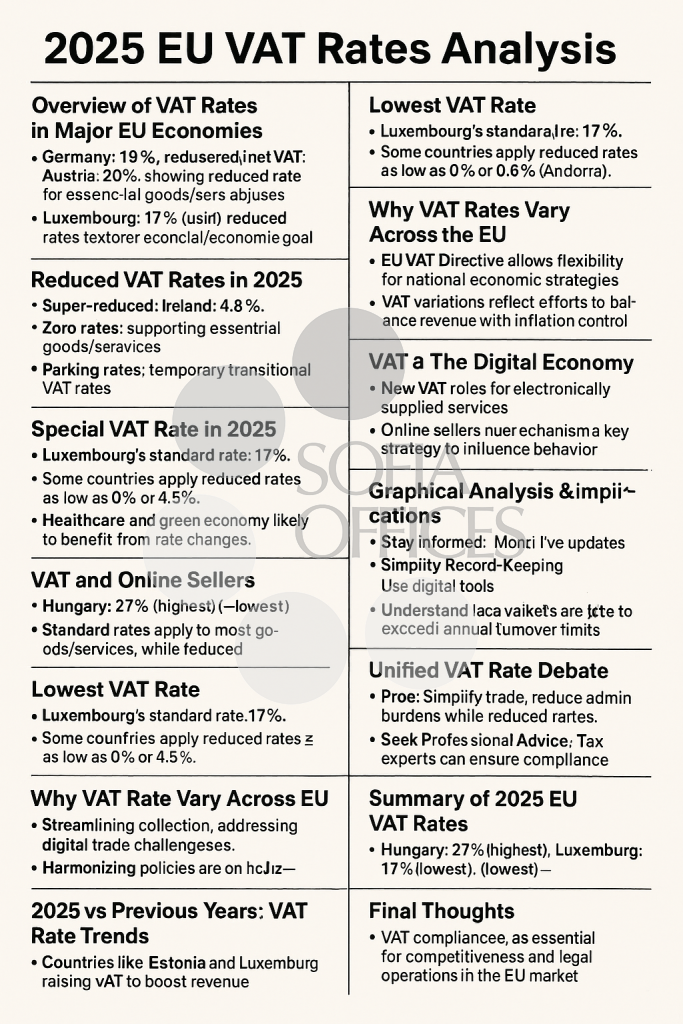
Overview of VAT Rates in Major EU Economies
Germany: 19%, moderate rate.
Austria: 20%, showing close fiscal alignment with Germany.
Hungary: 27%, highest in the EU.
Luxembourg: 17%, lowest standard VAT rate.
Countries like France (super-reduced rate of 2.1%) and Italy use reduced rates to foster economic growth and support specific sectors.
Reduced VAT Rates in 2025
Reduced VAT rates help lower costs for essential goods/services, impacting both consumers and businesses.
Consumer Savings: Lower costs on food, transport, healthcare.
Business Growth: Higher demand in VAT-favored sectors like tourism or culture.
Administrative Considerations: Compliance complexity due to varying VAT rules across countries.
Special VAT Rates in 2025
Super-reduced, zero, and parking rates are permitted under EU law for essential policy goals.
Considering launching or expanding your e-commerce venture? Look no further than Bulgaria, a hidden gem in the European digital marketplace. With its burgeoning online consumer base, advantageous fiscal policies, and strategic geographic location, Bulgaria offers a ripe environment for digital storefronts.
This article delves into why Bulgaria is becoming a hotspot for e-commerce businesses, outlining the sector’s growth potential, key advantages to setting up shop, and essential steps to ensure success in this vibrant market. From insights into navigating local regulations to optimizing for a seamless mobile shopping experience, prepare to explore how Bulgaria could be the launchpad your online business needs to thrive.
Why Choose Bulgaria for Your E-Commerce Venture?
Bulgaria presents a compelling case for entrepreneurs and businesses looking to expand their e-commerce operations or start a new one. With a rapidly growing online market and a friendly business environment, Bulgaria offers a blend of opportunities that can appeal to a wide range of e-commerce ventures. The combination of a low corporate tax rate, a growing number of online shoppers, and the country’s strategic location in Europe makes it an attractive destination.
The Growing E-Commerce Market in Bulgaria
In recent years, Bulgaria has witnessed significant growth in its e-commerce sector, exhibiting annual increases in online consumer numbers and e-commerce’s contribution to the nation’s GDP. Notably, the country has seen a surge in online shopping, with over 1.53 million customers making purchases online in 2019 alone. This trend reflects a broader shift towards digital commerce, driven by advancements in technology, increased internet penetration, and changing consumer behaviors. With e-commerce’s share in Bulgaria’s GDP jumping from 0.48% in 2014 to 1.53% in 2019, the trajectory indicates not just growth but accelerating adoption of e-commerce among both businesses and consumers.
Advantages of Starting an Online Store in Bulgaria
Setting up an online store in Bulgaria comes with several advantages. Firstly, the country boasts one of the lowest corporate tax rates in the EU at only 10%, regardless of where the goods or services are sold or shipped. This fiscal policy is highly beneficial for e-commerce businesses looking to maximize their profitability while servicing a global customer base. Additionally, establishing a company in Bulgaria is relatively straightforward, with the option to form a limited liability company with just 1 Euro in capital. The ease of business setup, coupled with a regulatory environment supportive of e-commerce, makes Bulgaria an attractive option for entrepreneurs.
Furthermore, Bulgaria’s laws ensure that online stores provide comprehensive information to consumers and authorities, ensuring transparency and fostering trust. The requirement to clearly display business information, VAT registration (if applicable), and adherence to the Bulgarian Consumer Protection Act, which allows customers to cancel orders within a 14-day period for a full refund, reassures both businesses and consumers by creating a safe trading environment.
Lastly, Bulgaria’s strategic location in Europe offers logistical advantages for e-commerce businesses aiming to serve European markets efficiently. Its positioning facilitates easy access to both EU and non-EU countries, making it an ideal hub for online businesses targeting customers across the continent and beyond.
In conclusion, the combination of a technologically evolving market, favorable economic policies, and a supportive legal framework make Bulgaria a compelling choice for e-commerce ventures. By tapping into the growing digital consumer base and leveraging the country’s strategic advantages, businesses can unlock significant growth opportunities in Bulgaria’s vibrant e-commerce landscape.
What You Need to Know Before Launching Your Online Store
Before stepping into the e-commerce arena in Bulgaria, understanding the foundational steps can significantly enhance your business’s chance for success. Launching an online store is not just about having a wide array of products or services but ensuring that your business complies with local regulations, understands the market’s behavior, and utilizes the appropriate digital platforms. Let’s dive into these crucial aspects.
Legal Requirements for E-Commerce in Bulgaria
Navigating the legal waters of setting up an online store in Bulgaria is straightforward but requires attention to several key details. First, foreign entities can engage in e-commerce in Bulgaria without establishing a local presence, though they might need to register for tax purposes if selling from abroad. A local legal entity can also be an advantageous route, enjoying Bulgaria’s favorable corporate tax rate.
Ensuring compliance with the Bulgarian E-commerce Act and Consumer Protection Act is vital. Information transparency is a cornerstone of these regulations, necessitating that e-commerce operators provide clear access to business details including, but not limited to, the merchant’s name, address, contact information, and VAT registration if applicable. Online prices must include all taxes and fees, and advertisers must distinctly mark promotional messages. Furthermore, compliance with the European Union’s directives on e-commerce, particularly in aspects like data protection and consumer rights to contract termination within 14 days for a full refund, is mandatory.
It is additionally critical to make privacy policies available and to register according to the Bulgarian Protection of Private Data Act, offering consumers options regarding their data. Compliance with these regulations not only ensures legal operations but builds trust with your customers.
Understanding Bulgaria’s Consumer Behavior
The Bulgarian e-commerce market offers a rich tapestry of consumer behaviors and preferences. Bulgarians are increasingly embracing online shopping, driven by the convenience, variety, and competitive pricing it offers. This trend indicates a growing market with a wide range of opportunities for new entrants.
Consumers in Bulgaria, much like elsewhere, look for transparency, ease of use, and reliability in e-commerce platforms. They value clear information on pricing, shipping, and returns policies. Additionally, providing customer service in Bulgarian can significantly enhance customer trust and satisfaction. Recognizing these preferences and designing your online store to meet these expectations can set your business apart in a competitive landscape.
Choosing the Right E-Commerce Platform
Selection of an e-commerce platform is crucial as it affects every aspect of your online business, from inventory management to customer service. The right platform should offer a balance of customization, scalability, security, and user-friendliness. Popular options include Magento, WooCommerce, and Shopify, each with its strengths and best-use scenarios. For instance, Magento offers powerful customization options suitable for larger businesses with specific needs, while Shopify provides user-friendly interfaces ideal for newcomers to e-commerce.
Ultimately, understanding and meeting legal requirements, tapping into consumer behaviors, and choosing the right e-commerce platform are indispensable steps towards launching a successful online store in Bulgaria. Each of these aspects plays a pivotal role in establishing a robust, competitive, and legally compliant e-commerce presence in this dynamic market.
Building Your E-Commerce Store: Step-by-Step Guide
Entering the Bulgarian e-commerce market is a strategic move for businesses aiming to expand their digital footprint in Eastern Europe. With its growing online consumer base and favorable tax conditions, Bulgaria presents a lucrative opportunity for e-commerce merchants. This guide provides a comprehensive walkthrough for setting up your online store, ensuring you meet local requirements while maximizing your store’s potential.
Selecting Products to Sell in Bulgaria
The first step in establishing your e-commerce presence in Bulgaria involves selecting the right products. Understanding local consumer behavior and preferences is essential. Research top-selling items and trends within the Bulgarian online market. Consider goods with lower local availability but high demand, as these can offer competitive edges. Ensuring product compliance with EU and Bulgarian regulations is also crucial, as is being aware of any restrictions on certain items.
Navigating Payment Gateway Options
Offering a variety of payment options can significantly enhance your store’s conversion rates. In Bulgaria, along with traditional credit and debit card payments, consider integrating local payment solutions that customers are familiar and comfortable with. Look into popular local systems such as ePay and BORICA. As security is paramount in online transactions, opt for payment gateways that offer robust encryption and data protection to build trust with your customers.
Optimizing for Mobile Shoppers in Bulgaria
With mobile commerce on the rise in Bulgaria, ensuring your e-commerce site is mobile-friendly is not optional; it’s necessary. This involves designing your site with a responsive layout that adjusts seamlessly to different screen sizes, improving loading times, and simplifying the checkout process for mobile users. High-quality images and a streamlined navigation menu enhance the mobile user experience, leading to better engagement and conversion rates.
Strategies for Digital Marketing and SEO in Bulgaria
To capture and maintain the attention of the Bulgarian online market, a robust digital marketing and SEO strategy is essential. Start with keyword research focused on Bulgarian search terms related to your products. Utilize local SEO practices to improve your visibility in local search results, including adding your business to Bulgarian directories and Google My Business. Social media platforms are widely used in Bulgaria, so creating targeted ad campaigns can increase brand awareness and drive traffic to your site. Influencer collaborations can also provide an authentic connection with potential customers. Remember, content is king, so provide valuable and engaging content that resonates with your Bulgarian audience.
In conclusion, stepping into the Bulgarian e-commerce market requires a blend of strategic product selection, understanding of local payment preferences, mobile optimization, and targeted digital marketing. By following these steps, businesses can effectively establish and grow their online presence in Bulgaria.
The Logistic Side of E-Commerce in Bulgaria
The e-commerce landscape in Bulgaria offers a vibrant and expanding market for online shopping, necessitating an effective logistics framework to support the burgeoning demand. Addressing the logistic components of e-commerce not only enhances the customer experience but also streamlines operations, making Bulgaria an attractive destination for online businesses.
Warehousing Solutions for Online Stores
Finding the right warehousing solutions is a crucial step for online stores aiming to succeed in the Bulgarian market. Efficient warehousing ensures that products are stored safely and are easily accessible for quick dispatch. When considering warehousing in Bulgaria, online businesses should look for facilities that offer:
Modern technology for inventory management to track stock levels accurately,
Flexible storage space that can adjust to varying inventory sizes,
Strategic locations near transportation hubs to expedite shipping processes.
Implementing such warehousing strategies can significantly reduce lead times and improve the overall customer satisfaction.
Efficient Shipping Strategies Within Bulgaria
Shipping is at the heart of e-commerce success in Bulgaria. An effective shipping strategy encompasses prompt delivery times, reasonable shipping costs, and reliable service. Online retailers operating in Bulgaria should:
Select shipping partners with a solid track record of timely deliveries within the region.
Offer multiple shipping options to meet the diverse needs and preferences of customers.
Consider incorporating free shipping thresholds to encourage larger purchases.
Additionally, clear communication with customers about shipping policies, tracking information, and expected delivery times fosters trust and reduces potential friction points.
Dealing With Customs, Taxes, and Duties in Bulgaria
For e-commerce businesses that ship internationally to Bulgaria, navigating the complexities of customs, taxes, and duties is essential for a seamless customer experience. To efficiently handle these aspects:
Determine the applicable HS codes for products to accurately calculate taxes and duties.
Utilize automated solutions for tax and duty calculations to ensure accuracy and save time.
Provide customers with upfront costs, including taxes and duties, to prevent unexpected charges and enhance transparency.
Understanding and complying with local regulations not only streamlines the import process but also builds customer confidence in the brand. By addressing the logistics of warehousing, shipping, and handling customs efficiently, online stores can effectively tap into the growing e-commerce market in Bulgaria, ensuring customer satisfaction and fostering business growth.
Expanding Beyond Bulgaria: Tips and Considerations
As your e-commerce venture thrives in Bulgaria, venturing into new markets can be the next strategic move to scale your business globally. However, understanding the intricacies of entering new territories is vital for a smooth expansion. This guide lays down essential tips and considerations for merchants eyeing international growth, ensuring a well-informed approach to global e-commerce.
Identifying Potential Markets for Expansion
Choosing the right markets for expansion requires a blend of market research and strategic analysis. Here are key steps to identify lucrative opportunities:
Market Size and E-commerce Readiness: Analyze the size of the potential market and its openness to e-commerce. Look for markets with a growing digital infrastructure and a high internet penetration rate.
Customer Behavior and Preferences: Understanding local consumer behavior and preferences is crucial. Research on popular product categories, payment methods, and shopping trends to assess the market’s compatibility with your offerings.
Competition Analysis: Evaluate the competitive landscape. Identifying local and international players already in the market can help understand the market saturation and find your unique selling proposition.
Regulatory Environment: Familiarize yourself with the local laws and regulations governing e-commerce. This includes tax obligations, consumer protection laws, and data privacy regulations.
Logistical Considerations: Assess the logistical aspects such as shipping options, costs, and the efficiency of local delivery systems. Efficient logistics are key to ensuring customer satisfaction in a new market.
Combining this data will enable a comprehensive view of potential markets, guiding an informed decision-making process.
Cross-border E-Commerce: Legal and Logistic Challenges
Entering international markets is accompanied by a set of legal and logistical challenges that businesses must navigate carefully:
Understanding Local Laws: Each country has its own set of e-commerce regulations, tax laws, and compliance requirements. Ensuring legal compliance is fundamental to operating smoothly and avoiding penalties.
Payment Processing: Incorporating local payment methods is essential for customer convenience. This may require partnering with local payment processors and ensuring transactions are secure.
Localization Strategies: Localization goes beyond translating your website into the local language. It involves adapting your marketing strategies, product offerings, and customer service to meet local tastes and preferences.
Shipping and Returns: Developing a cost-effective logistics strategy is crucial. This includes finding reliable local shipping partners and setting up a clear returns policy that aligns with local norms and consumer expectations.
Data Protection: Adhering to local data protection laws, such as the GDPR in Europe, is a must. Businesses should implement robust data security measures to safeguard customer information, emphasizing the importance of using reliable security software to prevent data breaches.
Overcoming these challenges requires careful planning, research, and sometimes partnership with local experts. As you foray into new markets, staying flexible and adaptable to changing regulations and consumer behaviors will be key to your international success.
Maintaining Your E-commerce Store’s Security
Online stores, by their nature, handle a significant amount of personal and financial information. This makes them attractive targets for cybercriminals. As e-commerce continues to grow, especially with the increased use of mobile devices for shopping, implementing strong security measures becomes increasingly essential.
Interviews With Successful Bulgarian E-Commerce Entrepreneurs
Insights from those who’ve made a mark in the Bulgarian e-commerce scene highlight the importance of local knowledge, customer-centric approaches, and adaptability. Entrepreneurs share their journey, discussing the challenges they faced and how they overcame them, such as optimizing for local payment methods, navigating legal and tax requirements, and tailoring their marketing strategies to connect with Bulgarian consumers.
What Worked for Them: Tips and Advice
From these success stories emerge invaluable tips for succeeding in Bulgaria’s e-commerce market:
Understand the Local Consumer: Tailoring your product offerings and marketing techniques to fit the preferences and behaviors of Bulgarian consumers can significantly boost your success. This includes understanding popular products and how consumers in Bulgaria prefer to shop online.
Localize Your Store: Translation isn’t just about changing words from one language to another. Successful entrepreneurs stress the importance of full localization which covers cultural nuances, currency, and even adapting to local online buying behaviors.
Compliance with Local Regulations: Staying on top of legal requirements, including consumer protection laws and data protection regulations, is crucial. Ensure your e-commerce platform is fully compliant to build trust with your customers and avoid potential legal issues.
Optimize for Mobile: With a significant portion of online shopping in Bulgaria happening via mobile devices, ensuring your e-commerce site is optimized for mobile is crucial for capturing this audience.
Learning from those who have navigated the Bulgarian e-commerce market successfully can provide a roadmap for similar success. Their experiences underscore the need for a localized approach that respects the preferences and requirements of Bulgarian consumers and regulators alike. Emulating these proven strategies, while also bringing your unique value proposition, can help set your e-commerce venture on the path to success in Bulgaria.
Final Thoughts on Starting Your E-Commerce Business in Bulgaria
Launching an e-commerce business in Bulgaria presents a unique opportunity for entrepreneurs and business owners looking to venture into the European market. The country’s low corporate tax rate of 10%, coupled with a sizable and active consumer base, makes it an attractive landscape for online trade. Additionally, the possibility of setting up a business with a capital of just 1 Euro only adds to Bulgaria’s allure as an e-commerce hub.
However, embarking on this journey requires a keen understanding of the local legal landscape, consumer rights, and tax obligations. The Bulgarian E-commerce Act, The Consumers Protection Act, and other pertinent legislations set out strict guidelines on consumer rights, data protection, and advertisement, ensuring a fair and transparent marketplace. Compliance with these regulations is not optional but a fundamental part of operating successfully within the country.
Significantly, Bulgaria’s legal framework also extends protections to international consumers, underscoring the importance of adhering to EU directives. This extends the scope of responsibility for businesses, necessitating a thorough preparation and understanding of both local and EU-wide consumer protection measures.
The online retail environment in Bulgaria is robust, with top e-commerce sites indicating a healthy appetite for online shopping among the Bulgarian population. This is further aided by advancements in AI and machine learning, simplifying tasks such as localization, translation, and compliance with local product standards, thus removing some of the barriers to entry for foreign businesses.
Yet, it’s vital to note that launching and operating an e-commerce site involves more than understanding legal requirements and setting up shop. Ensuring your website is optimized for the local market, from language to payment methods, and even advertising, plays a crucial role in your business’s success. Localizing your e-commerce store isn’t just about translating content but adapting your entire operation to meet local demands and cultural nuances.
In conclusion, while entering the Bulgarian e-commerce market is fraught with challenges, it remains a venture worth considering for its potential rewards. With diligent preparation, legal compliance, effective localization, and a strong focus on cybersecurity, businesses can capture and thrive within Bulgaria’s dynamic digital marketplace.
The newly established Bulgarian Outsourcing Association made prognosis for a stable increase in the number of companies that plan to outsource their business to Bulgaria. These companies be registered in Sofia and could come from many spheres of activity. The new association predicted that the increase in the number of companies will be around three times in the next five years. The outsourcing business is considered among the most dynamic industries in the country and currently it employs around 15 000 people in the capital. Their number is expected to triple according to the five year prognosis. The stable political situation, the low taxes and the acceptable wages in the country, the professional skills of the employees, as well as its being part of the European Union, make Bulgaria an attractive destination for the large and stable companies in Western Europe and the United States. These companies will look for business centers with offices of the highest class, which have central and convenient locations and perfect infrastructure, besides offering an impressive range of services and facilities. It is believed that these big companies will later open other offices throughout the country in cities like Varna and Bourgas, Plovdiv and Rousse.
Among the founders of the Bulgarian Outsourcing Association are companies like Coca-Cola Hellenic IT Services, AII Data Processing, Sofica Group, Atos Bulgaria and Bulpros. They believe that if the state and the companies join their forces, this will lead to a stable development of that industry sphere. If the proper activities are arranged and successful policies are followed, then Bulgaria can become one of the top ten destinations for outsourcing. Special attention has to be paid to the professionals who apply for work in these outsourcing companies. Usually, these are people with a lot of knowledge and skills, but they still need training in certain spheres. It is not a secret at all that some of the largest outsourcing companies that are working in Bulgaria are in direct connection with the universities where they look for ambitious students. They try to attract the talented ones and offer them a job before they head to a carrier abroad. There is potential in the rest of the big cities in the country besides Sofia, where there are no such projects and opportunities, but there are still good professionals. The outsourcing industry is in demand for different types of employees – from recent graduates to managers and strictly qualified professionals.
In general, Bulgaria has excellent reputation among the companies in the outsourcing business and it will continue to attract them. The reasons for that are not only the membership of the country in the European Union, but also the tax alleviations and the desire for less bureaucracy. Of course, we should also mention the welcoming atmosphere, the excellent infrastructure and the construction of business centers with prestige location that correspond to the needs and the requirements that are important to the foreign investors.
The government of Bulgaria have allocated additional 20 million for three of its southeastern regions, I order to build a fence along the Turkish border. The fence that is referred to as a temporary deterring installation will be set to stop the migratory pressure on the border between Turkey and Bulgaria that have been growing in the past few years. According to the press statement by the government it will also stem the wave of the refugees.
Since 2014 for more than two years, the costs for the building of the fence have surpassed 100 million BGN. In addition, the cabinet have given more money to repair the border crossing, as well as the border police equipment and stations. All those measures have been done in relation with the hope for accession of Bulgaria in the travel-free Schengen zone.
In the end of October Romania and Bulgaria agreed that their aim to get a visa free traveling would be included in the interpretative declaration of CETA. This was an answer to the concerts that Wallonia, the Belgian region, had.
During the summit of the European Union, the Prime Minister of Bulgaria informed the press about the good news and the fact that the visa situation will be solved. Until that moment, Canada had a no visa regime with all countries from the European Union except with Bulgaria and Romania. Now the two countries do not have objection to CETA, yet they wanted to solve the visa issues they have with Canada. Different meetings have been held between the European Commission, Romania and Bulgaria, as well as Canada, aiming to solve this visa issue. Thus, since 1st December 2017 there will be no visas for residents of the two countries who want to enter Canada.
The regulation, which will come into force on 20th December will require all European Union countries to act as if one on all cases including visa matters. Romania and Bulgaria confirmed once again that they are ready for entering Schengen area for several years already, yet they have been prevented by vetos from several countries.
The new European border and coast guard control was launched in an official ceremony this autumn at the checkpoint Kapitan Andreevo, on the border between Turkey and Bulgaria. This border is also considered an external border of the European Union. The new task force was organized and built by the border management agency Frontex due to the overwhelming refugee situation.
The new European border and coast guard control will have new powers and more staff – approximately 1500 guards and technical equipment. In addition, liaison officers will be stationed in various states of the European Union that have external borders and will monitor the movements.
Until now Frontex was not able to offer effective control on the external borders of the European Union due to the lack of staff and the limited powers of the agency.
The European border agency have been inaugurated at Kapitan Andreevo checkpoint between Bulgaria and Turkey border in October this year. The two countries are now separated with a razor wire and a metal fence. The European border agency aims to be the main frontier on land for the migrants that want to enter Europe but avoid the crossing of the Mediterranean Sea.
Approximately 1500 officers and 19 state members will be at the disposal of the European Border and Coast Guard Agency, who can be quickly mobilized if there is an emergency. Officials from the European Union hope that this will increase the security and will help the cooperation between the various member states that have been arguing in connection with the refugees.
It seems that the long-term goal is for lifting the border controls that are inside the block and for restoring the passport-free area of Schengen. The director of the EBCG, Fabrice Leggeri, stated that the new agency is well equipped and quite strong to cope with the security challenges and the migration situation.
According to Dimitris Avramopoulos, the EU Migration Commissioner, since the launching of the new European Border and Coast Guard Agency, the external border of Bulgaria becomes an external border of all member states. The agency will further be involved in the repatriation of those migrants that have been rejected from the asylum and are accepted as a threat to the security.
Bulgaria got a positive assessment by the Interior Minister of Poland Mariusz Blaszczak on a meeting he held with the Deputy Prime Minister and Minister of the Interior Rumiana Bachvarova. The Bulgarian Prime Minister stated that Bulgaria has a very important role in guarding the most sensitive external border of the European Union, making all efforts possible to limit the illegal immigration. Bulgaria has a good organization that restricts the crossing of the illegal migrants. Thanks to that organization, the immigrants are restricted to cross Bulgaria as they are detained entrance on the country’s territory. This is a very strong message to the migrants stating that Bulgaria is not easy to cross.
Bulgaria gets support from the European states and officers coming from other countries. Currently are being detained around 200 people each week, which is less than the same period in 2015. The Deputy Prime Minister also stated that Bulgaria makes everything possible to guard its external border, which is also an external border of the European Union. The Polish guest showed the strong support of Poland for the accession of Bulgaria in the Schengen zone.
We use cookies on our website to give you the most relevant experience by remembering your preferences and repeat visits. By clicking “Accept All”, you consent to the use of ALL the cookies. However, you may visit "Cookie Settings" to provide a controlled consent.
This website uses cookies to improve your experience while you navigate through the website. Out of these, the cookies that are categorized as necessary are stored on your browser as they are essential for the working of basic functionalities of the website. We also use third-party cookies that help us analyze and understand how you use this website. These cookies will be stored in your browser only with your consent. You also have the option to opt-out of these cookies. But opting out of some of these cookies may affect your browsing experience.
Necessary cookies are absolutely essential for the website to function properly. These cookies ensure basic functionalities and security features of the website, anonymously.
Cookie
Duration
Description
cookielawinfo-checkbox-analytics
11 months
This cookie is set by GDPR Cookie Consent plugin. The cookie is used to store the user consent for the cookies in the category "Analytics".
cookielawinfo-checkbox-functional
11 months
The cookie is set by GDPR cookie consent to record the user consent for the cookies in the category "Functional".
cookielawinfo-checkbox-necessary
11 months
This cookie is set by GDPR Cookie Consent plugin. The cookies is used to store the user consent for the cookies in the category "Necessary".
cookielawinfo-checkbox-others
11 months
This cookie is set by GDPR Cookie Consent plugin. The cookie is used to store the user consent for the cookies in the category "Other.
cookielawinfo-checkbox-performance
11 months
This cookie is set by GDPR Cookie Consent plugin. The cookie is used to store the user consent for the cookies in the category "Performance".
viewed_cookie_policy
11 months
The cookie is set by the GDPR Cookie Consent plugin and is used to store whether or not user has consented to the use of cookies. It does not store any personal data.
Functional cookies help to perform certain functionalities like sharing the content of the website on social media platforms, collect feedbacks, and other third-party features.
Performance cookies are used to understand and analyze the key performance indexes of the website which helps in delivering a better user experience for the visitors.
Analytical cookies are used to understand how visitors interact with the website. These cookies help provide information on metrics the number of visitors, bounce rate, traffic source, etc.
Advertisement cookies are used to provide visitors with relevant ads and marketing campaigns. These cookies track visitors across websites and collect information to provide customized ads.